Back to list
Head of Department : Melanie Legg – English
Head of KS3 English: Sophie Davies
Head of KS4 English : Milly Bull-Mittens
Head of KS5 English: Jo Colby
Head of Department: Claire Pearson – Media
Head of Department : Alex Banks – European Languages
Head of KS3 European Languages – Rhoda Bevan
Head of Department: Andrew Zhang – Mandarin KS3 and CLIL
Head of Department: Jia Li – Mandarin KS4 and KS5
E: enquiries@bohunt.hants.sch.uk; T: 01428 724324
Intent
As Team English, we firmly believe that our students should experience and enjoy an accessible, inspiring and challenging curriculum.
Our curriculum endeavours to teach skills to develop engaged and informed critical thinkers who are able to confidently interact with the different worlds they face. By exposing our young people to a vast breadth and depth of literature, spanning the 1500s to the present day, we go beyond National Curriculum and GCSE requirements to showcase the variety, richness and power of the English Language. Prose, poems, plays, novels and non-fiction texts are enjoyed and used to develop robust, reflective and precise reading and writing skills. Fostering a love of reading – reading for knowledge, reading for pleasure – lies at the absolute heart of what we do.
We want students to not only hear a wide range of voices but to empower our young people to critique, question and challenge the status quo to gain a wider knowledge of the society around them. In doing this, students deepen their understanding of literacy, craft their analytical skills, and observe connections between texts and the contexts in which they are written.
Ultimately, our curriculum ensures that students are world-ready: confident to articulate their ideas, opinions and values, and skilled at thinking and reading critically. Our young people will be able to celebrate theirs and other people’s successes. Our game-changers will depart very conscious of both their powerful potential and the active role that they will fulfil in society.
Download the English Learning Journey
Implementation
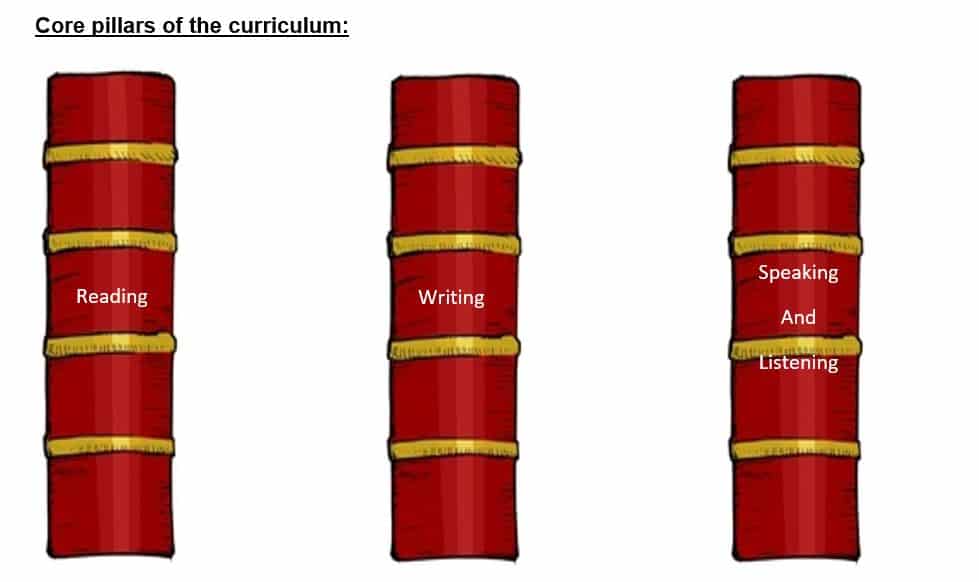
In English, we teach mastery of key skills via a spiral curriculum- which means we repeat the same key skills each year as we develop the depth and the range of those skills.
Within the Bohunt curriculum of generic topics and development of key skills, we have focused upon provision which is rich, empowering and enjoyable – by going beyond assessment topic and by challenging to the top with support to access as our mantra. We planned a variety of topics, tasks, skills required and genres.
All our lessons are focused on challenging and the steps and scaffolds to access the learning. We plan to teach in a variety of ways. Bookwork shows that the delivery of lessons includes a range of methods and tasks to engage, challenge and support
Teachers model and scaffold. They give clear guidance in lessons and feedback individual next steps for improvement
We use the mastery model to sequence and repeat skills across KS3. We sequence learning at KS3 as we seek to engage then improve. We seek to include all in each lesson and implement our planning by applying the FOCUS skills and tasks.
Implementation under the mastery approach includes:
Impact
Through the sequencing of learning and the opportunities which we provide our learners in both English Language and English Literature we support the development of critical and creative thinkers.
Alongside our academic successes, we feel our most valuable outcomes are with those students who succeed in areas which cannot be examined: in empathy, in confidence and in growing self- recognition that the potential we see in them is boundless.
“The future world of work will put a premium on critical and creative thinking. That in turn will put a premium on studying the critical creative thinking subjects such as English which demand close analysis and structured, concise argument alongside creative, personal spark. “
Andrew Haldane: Chief Economist at the Bank of England
“The ability to be an agile thinker – able to communicate quickly and with purpose – as you decode the issues around you succinctly and accurately is such a key skill in our world that employees who can demonstrate their background in mastery of these skills do very well very quickly. English does really help nurture and develop these critical thinking and communication skills”
Kate McLaughlin: Lloyds Banking Group
Additional experiences and opportunities for learners include:
Learner feedback:
“Thank you for having faith in me when I did not have it in myself. You made me work but kept each part of it clear. I did not realise how much I knew until I did those exams and I really want to thank you for helping me pass.”
PP boy – passed both GCSEs in English in 2019 after struggling with the subject
“Thank you! You have changed me as a reader and as a person! I loved your classes as you made me think and question things in a way I had not before. The skills and steps of analysis were so clear that I felt confident with developing my own arguments. Literature has changed my life!”
PP girl who completed GCSEs in 2017 went on to study English Literature A-level with us in 2019 and now studies English at University
Learner Outcomes:

Intent
Our curriculum is built on the intention and desire to teach key skills of digital literacy, to embed and develop critical, engaged, informed students who can respond to the media they consume through a range of skills. Further, we teach the appreciation that all media texts are constructed, using media language, to construct representations for different audiences within the industries which created them. Students develop an appreciation and understanding of the context in which media texts are produced and how this affects their reception. We go beyond the GCSE requirements in order to provide stretch and challenge to our most able students, and to provide stimulating, engaging and varied examples for study.
We nurture and develop critical thinking and seek to create engaged and digitally literate consumers and producers of media texts. We do this by planning a curriculum which repeats and embeds assessment skills – through the mastery model – to secure these skills and create confident, reflective learners, using feedback and opportunities for DIRT. We explore the paratexts of media texts to create cultural capital. This supports students’ understanding and appreciation of the importance of context.
Students complete tasks to create their own media texts to further embed and develop key skills but to also provide opportunities to work imaginatively with autonomy, using technology to enhance the production of their own texts.
Implementation
Impact
Media studies at Bohunt develops students’ digital literacy, empowering them to become critical users of media texts. Students develop knowledge and understanding of how media texts are constructed, enabling them to apply critical readings of these texts; they are able to identify how meanings are embedded in media texts. As students progress through the course they extend this ability to identify how ideologies and values are encoded in media texts, considering the extent to which we are influenced by the media and its producers, whether this be individuals or global conglomerates. Students are challenged to consider how we can apply academic theories to support and develop a line of argument and to evaluate how useful these theories are in an ever-evolving and rapidly changing media landscape.
The texts chosen for study represent culturally significant media products, exploring how representations of people, places and issues have changed over the decades and to enable students to consider the context of production and how this influences the production and consumption of media texts. The impact of new technologies and platforms is also investigated as well as the role of the audience, especially the extent to which the audience becomes part of the media product.
Students are encouraged to respond creatively, completing practical production projects, designing their own media texts for specific audiences.
Examples of learner work within Media Studies:
https://drive.google.com/drive/folders/1A8tTMw5RrGl9sIPoyXpXzsKPdo2glbkN
Enrichment opportunities:
Trips to Sky Studios
Guest speakers form Solent University – media production and Media Studies in further education
BBC Radio News Team – workshops with students in creating news content for radio
Advertising/Marketing workshop with Molly Ayo from Wavemaker (London based agency for Media, Content, Technology)
BBC Schools News Report
Learner Outcomes:

The importance of MFL and our Intent:
The ability to speak and understand a Language is a life skill which will benefit you way beyond your academic qualifications and your school days. Learning languages allows for ways of communication which open doors in travel, working abroad in any role, understanding businesses better and being more open to international business . Your demonstration of skills of learning and application show that you embrace and welcome these opportunities. Most importantly though, learning a language is fun! Here at Bohunt, we follow the Edexcel syllabus and within that there is a real focus on history and culture behind the languages you will study. Learning about another country helps to widen your thinking, expectations, and future experiences of the world. We are proud of our Language provision at Bohunt and we are lucky to have a range of specialist, skilled teachers who drive that enjoyment of languages forward. All languages share the same skills around listening, speaking, reading, and writing. French and Spanish involve skills of understanding and using European and world- wide languages whilst studying Mandarin offers a particularly special opportunity which is not offered at many schools but here at Bohunt, we have a thriving department. Languages are the passport to your future worlds, and we look forward to helping you choose which language/s to study for your GCSE.
Intent:
The MFL Curriculum provides students with the knowledge, skills, values and attitudes to navigate the world successfully and become the next generation of game-changers.
Summary of subject intent statement:-
KNOWLEDGE – It provides students with opportunities to:
SKILLS – It empowers students with the tools to:
VALUES – It encourages students to:
ATTITUDES – It inspires students to:
Studying languages goes far beyond the GCSE specification. We aim to introduce the subject, to demonstrate its scope and value to ensure students consider opportunities for further study.
Implementation
Delivering a rich and interesting curriculum which constantly builds on prior knowledge and increasing in complexity. Topics delivered are meaningful and age appropriate aimed at engaging learners and developing their curiosity for languages. Learning is sequenced to foster progression and allow for a meaningful transfer of skills across topics.
Students develop a richness of experience across French and Spanish developing their understanding and abilities across a range of skills including reading, writing, speaking and listening. Students explore the application of language by encouraging curiosity, looking for patterns in language and drawing upon their knowledge of the English Language to support. Emphasis is also placed on understanding and respecting the cultures of the countries where the language is spoken.
Within both French and Spanish we run a content and language integrated learning pathway (CLIL) for students to become fully immersed in the learning and development of one specific language. Students will undertake PE, Drama, Art and PSRE lessons in their target language developing their exposure to the language and culture to enhance their learning experience. Students who undertake these programmes are entered for GCSE in year 9 followed by DELF (Diploma in French Language Studies) or DELE (Diploma of Spanish as a Foreign Language) examinations in year 11.
Download the Five Year French Learning Journey
Download the Five Year Spanish Learning Journey
Impact
Through the MFL curriculum, we create and encourage learners who remain curious but who leave with a greater sense of insight into and appreciation of other cultures, other histories and other ways of enjoying and expressing life. MFL is more than just learning the words of other languages; our impacts are that we create resilience learners who realise that they can make mistakes and improve through the process. The cultural capital experiences of trips, visits and exchange programmes create confidence, independence and the mind-set that the world is out there. The ability to communicate in that world and seek to explore it further is our impact
Additional experiences and opportunities for learners could include:
KS3:
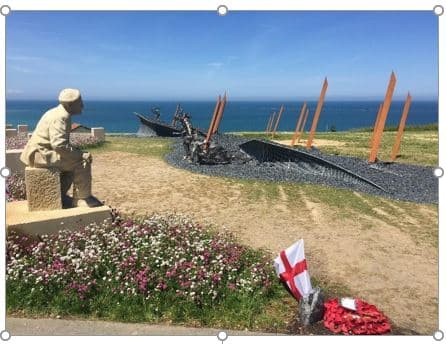
French Normandy Study visit
Spanish Barcelona Study visit
Onatti Theatre experience
BFI Film and Culture Club
European Day of Languages Activities
KS4:
Spanish Exchange to Madrid
French Exchange to Marseille
Onatti Theatre
BFI film study day trip
MFI Film and Culture Club
Speaking Cafes at lunchtime
Careers with languages external speakers
KS5:
BFI film study day trip
Film studies at the Living Room Cinema
Careers with Languages external speakers
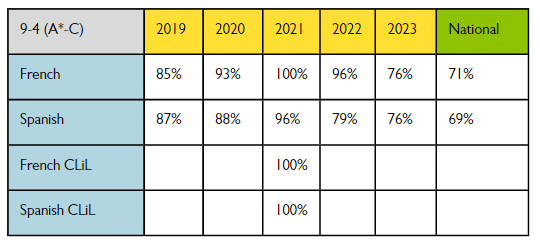
Learner Outcomes:
Intent
‘Learning a foreign language is a liberation from insularity and provides an opening to other cultures.’ Our intent is to embed joy and confidence in Mandarin language learning, to provide the knowledge, skills, values and attitudes to navigate the world successfully and to expand awareness of cultures, through challenge and support to create game changers who are resilient, can think independently, and are willing to take risks as they develop these skills.
We aim to provide opportunities for pupils to communicate in Mandarin for practical purposes, learn new ways of thinking and appreciate great literature in Mandarin.
Implementation
Mandarin programmes of study are planned and delivered in a logical sequence building on key themes and content culminating in a deeper understanding and application of the main topics and vocabulary.
Mandarin lessons are based upon interactive, engaging and collaborative structures with clear consolidation of core concepts fundamental to learning. Students focus upon developing the 4 skills of speaking, listening, reading and writing throughout the duration of the course whilst interweaving the thematic studies in each academic year.
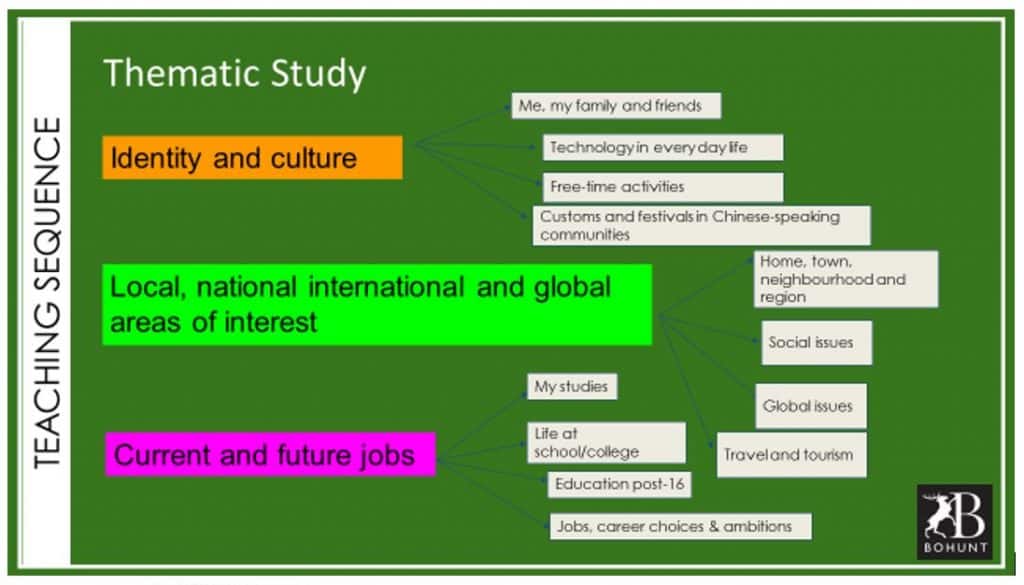
Within Mandarin we also offer students the opportunity to undertake the content and language immersion learning (CLIL) programme studying lessons in Art, PE, Drama, Music, ICT and PSRE in their target language. This allows students increased exposure to the Chinese language and culture supporting them in undertaking their GCSE examination in year 9 followed by HSK 3 and HSK4(International Chinese Proficiency Test ) examinations in KS4. The Mandarin department also works in collaboration with the Mandarin Excellence Programme (MEP), such relationships allow students to develop their studies and opportunities in Mandarin.
Co-curricular activities and trips enable learners to develop their real-world communication skills in Mandarin and further deepen their understanding of Chinese culture and principles. These opportunities include:
KS3:
Cross Trust cultural activities
In school Chinese cultural activities
Trips to local Chinese restaurants
Mandarin Club
KS4:
Cross Trust cultural activities
Trips to UK universities
Trips to British Museum and Chinatown
China Trips for CLIL students in Year 9, for all learners in Year 10
MEP intensive learning activities
Impact
Mandarin creates students who face a particular challenge of responding to and mastering a language with different roots from our European languages – so alongside access to a whole new world of opportunities in communications and access, our learners realise with a growing confidence and sense of pride just what determination, resilience and motivation they have and what they can achieve when they apply these skills together. For us, Mandarin learning creates game changers in every student.
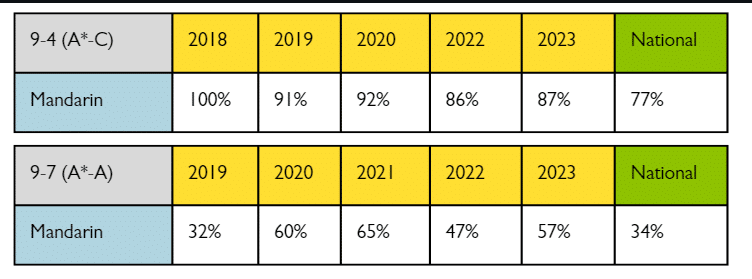
Learner Outcomes: