Computing, Business and Technology - Bohunt School Liphook

Menu

Quick Links

Category

Computing, Business and Technology

Head of Faculty: Jake King

Head of Department: Lyssa Badger (KS3 & 4 Computing)

Head of Department : Robin Smith (KS5 Computing)

Head of Department : Char O’Callaghan (Design & Technology)

Head of Department : Sue Schofield (Economics)

E: enquiries@bohunt.hants.sch.uk; T: 01428 724324

Computing & IT

Computing and IT – Intent

According to the Royal Society

“Data and digital technologies promise revolutionary transformational changes across the full range of industry sectors and spheres of life. This unprecedented digital revolution will impact everyone. It will have extraordinary implications on the range of skills that today’s young people will require in every aspect of their lives. Computing education must enable young people to continue to keep up with the pace of technological change so that they can remain effective, well-informed and safe citizens.”

Computing and IT is such an important part of the world we live in, the intention of the Computing curriculum at Bohunt is to:

  • Enable our students to thrive and flourish in a digital world
  • Enhance and extend our student’s learning across the whole curriculum whilst developing resilience and independence.
  • Equip our students with the knowledge, confidence and skills to understand and change the world.
  • Inspire our students to become “Gamechangers”.

Our curriculum is built on the intention and desire to teach skills to embed and develop critical, engaged, informed students who can react to the worlds round them through a range of skills and topics. We go beyond the GCSE requirements in order to educate students about the computing concerns of the day.

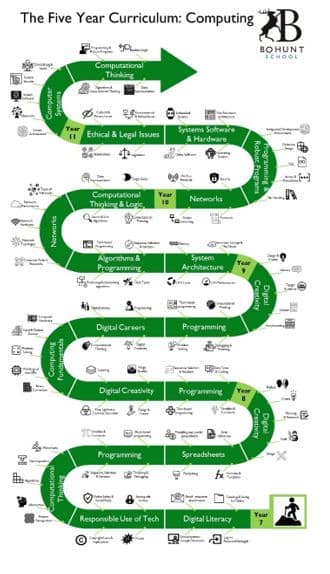
The main topics and skills the students cover in each year of the Computing curriculum include:

Year 7

  • Confident in the use of the school IT systems including Google Classroom and Google Drive and the Microsoft Office products.
  • Safe use of computers including e-safety and the need for strong passwords
  • Introduce programming through block-based languages
  • Digital creativity through Sketch Up

Year 8

  • Introduction to text based programming using Python
  • Image manipulation through Photoshop
  • Understand the internal components of a computer
  • Understand why computers use binary
  • Digital creativity through Comic Life

Year 9 – 11

  • We look at the various hardware components within a computer to allow students to have informed discussions when purchasing new devices
  • Networks are investigated to give students confidence in using Cloud based services and fixing home broadband issues
  • As we live in a world driven by algorithms, it is important that students are able to identify, create and interpret algorithms in order to solve real world problems
  • Programming is the expression of a student’s problem solving skills and the Python programming language is used to allow students to create solutions to problems.

Download the Computing Learning Journey
Computing and IT – Impact

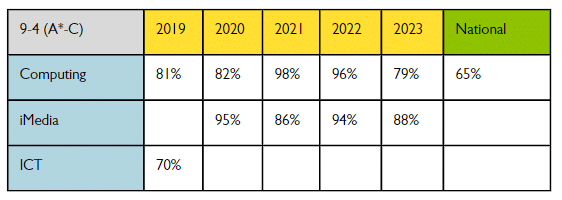
Our curriculum and extra curricular opportunities inspire our students to become game changers in a digital world. We arm our students with a range of skills that today’s young people will require in every aspect of their lives, whilst equipping our students with the skills required to keep up with the pace of technological change so that they can remain effective, well informed and safe citizens. This can be evidenced by the high proporation of students who persue a further qualification in Computing or move into a IT related career.

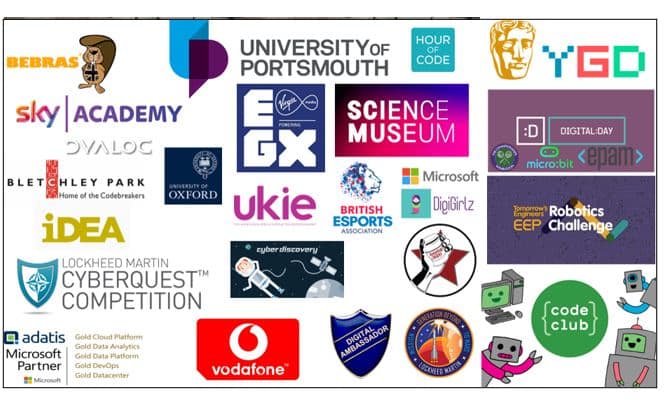
“The Computing Department offer a wide range of extra curricular opportunities, many of which are linked to industry. Here are just a few examples of the many institutions and companies we work with.”
 

This image has an empty alt attribute; its file name is symbol-lightbulb.jpg

This image has an empty alt attribute; its file name is scales.jpg

This image has an empty alt attribute; its file name is Computing-and-IT-Learning-Outcomes.jpg

Business and Economics

This image has an empty alt attribute; its file name is financial-times.jpg

Business and Economics – Implementation

Business:

Year 9

  • In year 9 we introduce students to the language and models of Business through the use of real world case studies
  • We build an understanding of why business exist, why and how certain people start them and the key functions within any business environment
  • We nurture a spirit of enterprise through practical business challenges. This includes participating in an enterprise challenge called MicroTyco, where profits are given as loans to entrepreneurs in developing countries.
  • We explore the role of marketing in business
  • We discuss and evaluate the different factors that businesses have to weigh up in making decisions

Year 10 & 11

  • In year 10 we explore different functional areas within business including human resource management, production and finance
  • We analyse the impact of businesses on the environment and society as a whole including case studies of businesses who are using new and innovative approaches to improve their social and environmental impact.
  • We investigate business behaviour in a holistic way looking at the interdependent nature of decisions for example looking at how production decisions will impact on marketing and financial concerns

Economics:

Year 9

  • In year 9 we introduce students to the language and models of economics through the use of real world issues
  • We build an understanding of how prices are determined in a free market economy and introduce students to the concepts of supply and demand.
  • We investigate the price of houses in the area and compare to other areas of the UK and other countries and discuss the reasons for their differences
  • We begin to explore personal financial literacy by understanding how mortgages and interest work
  • We investigate and discuss how wages are determined and why some people earn much more than others
  • We look at the role of government and decisions by the government to intervene in markets to change prices eg the sugar tax
  • We look at global trade and raise awareness of global inequalities

Year 10 & 11

  • In year 10 we explore further market forces and the impact of supply and demand
  • We look at competition in markets and the impact this has on producers, consumers and governments
  • We investigate in more detail the role of the labour market and the importance and determination of wages
  • We look at the financial sector of the economy and its role in the UK
  • We investigate the objectives of governments and the policies they can use to influence the economy
  • We investigate patterns of international trade and the reasons for trade.

Business and Economics – Impact

Our curriculum intent is demonstrably wider than the exam specification as evidenced by the extra-curricular trips and activities that form an engaging and educational lynchpin to the academic concepts covered in the course.

  • Micro Tyco
  • Peter Jones Foundation
  • Enterprise Day
  • Surrey University PP Enterprise Competition
  • Bank of England speaker
  • Investment Challenge Competition

Economics

“My favourite topics were international trade and the global economy.  I like these topics as I am particularly interested in learning about other country’s economic situations. This opens up your mind not to just focus on the UK economy but also others.”

“I really like the fact that economics has helped me to understand how the world works.  I find it fascinating to learn how the economy works and how it affects our lives on a daily basis.  For example, we have learnt about the financial sector of the economy.  We use money all the time but I have never really understood about it until now.”

“When I read/hear the news I understand the immediate and long term effects something will have. I know it will help me to make smarter decisions in the future.”

Business

“Business Studies helps you understand how any business works and can help you in any career you chose.”

“Business Studies is a great subject all round. One of the best things about Business Studies is how interactive the lessons are. In my lessons, we get to do a lot of independent research tasks and talk to our peers about the work and get different views on the subject. We also do a lot of activities.”

“Business Studies is a great subject all round. One of the best things about Business Studies is how interactive the lessons are. In my lessons, we get to do a lot of independent research tasks and talk to our peers about the work and get different views on the subject. We also do a lot of activities.”

“I would recommend Business Studies because you will use business in your every day life even if you do not end up owning your own business. Business Studies helps you to make quick and sensible decisions. Business Studies helps you to develop your leadership skills and your confidence as they are very important skills needed to run a business”

Download the Business Learning Journey

Download the Economics Learning Journey

This image has an empty alt attribute; its file name is Business-and-Economics-Learner-Outcomes.jpg


Design & Technology

Technology – Intent

Vision

To develop Independent, Creative, Problem solvers who are game changers in their chosen field in the future.

Intent

Design Technology at Bohunt prepares students for the fast pace of tomorrow’s rapidly changing world, with new emerging and disruptive technologies. We are committed to helping all students achieve their full potential to enable them to thrive in the future. In Design Technology students will combine practical technological skills with
creative thinking to design and make solutions fit for purpose drawing on knowledge from Science, Engineering, Mathematics, Computing and Art disciplines. They utilise this knowledge to become informed chefs, consumers, designers and innovators considering the impact that aesthetic, cultural, economic, emotional, environmental, ethical, health, and social issues have upon everyday objects. Students in Design and Technology will learn to
take risks in a safe and positive environment to become confident and self motivated learners. The subject encourages students to become autonomous and creative problem solvers who can work both independently and as part of a team to become forces for change.

Technology Implementation

Key stage 3:

All Students in Key stage 3 (years 7 & 8) are taught on a rotation and will cover all specialist areas over the course of 9 weeks. The areas include Food Technology, Electronics and control, Design technology (workshop) and Textiles covering the elements below.

  • Students will learn how to identify hazards and how to minimise these in the specialist rooms for the different areas including hygiene when dealing with food.
  • Students will gain an introduction to using CAD programs and producing an outcome using CAMM.
  • Students will learn to analyse existing products to identify USP that make their design unique or appeal to their user.
  • Students will learn the sources of materials and ingredients and key properties.
  • Students will learn how to use different tool, equipment, utensils and machines safely with increasing accuracy.
  • Student will learn about different finishes, surface techniques or presentation techniques.
  • Students will develop their dexterity skills

Key stage 4 Design Technology:

  • Students will learn about the developments in materials technology and be aware of these and how these impact on the design and use of products.
  • Students will learn a broad understanding of the categorization and properties of a range of different materials. They will learn about their source, use and application in products.
  • Students will become more critical in evaluation of new and emerging technologies and use this to inform their design decisions; considering contemporary and potential future scenarios from different perspectives, such as ethics and the environments.
  • Student will learn how energy is generated and stored in order to choose and use appropriate sources to make products and to power systems.
  • Students will learn to use CAD/CAMM to produce more complex designs and 3D modelling.
  • Students will learn the importance of electronic and programmable components to the product designer and end user and how such components are integrated into everyday products we use.
  • Student will learn different mechanical components and devices and the formulas and mathematics to work out ratios and mechanical advantage
  • Students will learn the sources, origins, physical and working properties of the material categories or the components and systems, and their ecological and social footprint
  • Students will learn the stock forms, types and sizes in order to calculate and determine the quantity of materials or components required
  • Student will learn the different processes that can be used to manufacture products to different scales of production
  • Students will learn  more specialist techniques and processes that can be used to shape, fabricate, construct and assemble a high quality prototype, including techniques such as wastage, addition, deforming and reforming, as appropriate to the materials and/or components being used
  • Student will learn appropriate surface treatments and finishes that can be applied for functional and aesthetic purposes
  • Students will understand that all design and technological practice takes place within contexts which inform outcomes.
  • Students will investigate factors, such as environmental, social and economic challenges, in order to identify opportunities and constraints that influence the processes of designing and making
  • Students will explore and develop their ideas, testing, critically analysing and evaluating their work in order to inform and refine their design decisions thus achieving improved outcomes.
  • Students will learn yo use different design strategies, such as collaboration, user-centred design and systems thinking, to generate initial ideas and avoid design fixation.
  • Students will develop, communicate, record and justify design ideas, applying suitable techniques, for example: formal and informal 2D and 3D drawing; system and schematic diagrams; annotated sketches; exploded diagrams; models; presentations; written notes; working drawings; schedules; audio and visual recordings; mathematical modelling; computer-based tools.
  • Students will make informed and reasoned decisions, respond to feedback about their own prototypes (and existing products and systems) to identify the potential for further development and suggest how modifications could be made.

Key stage 4 Food Preparation and Nutrition

  • Students will demonstrate effective and safe cooking skills by planning, preparing and cooking a variety of food commodities whilst using different cooking techniques and equipment
  • Students will develop knowledge and understanding of the functional properties and chemical characteristics of food as well as a sound knowledge of the nutritional content of food and drinks
  • Students will learn and demonstrate understand of the relationship between diet, nutrition and health, including the physiological and psychological effects of poor diet and health
  • Students will learn the economic, environmental, ethical and socio-cultural influences on food availability, production processes, diet and health choices
  • Students ill be able to demonstrate knowledge and understanding of functional and nutritional properties, sensory qualities and microbiological food safety considerations when preparing, processing, storing, cooking and serving food
  • Students will explore a range of ingredients and processes from different culinary traditions (traditional British and international) to inspire new ideas or modify existing recipes.
  • Students will develop a theoretical and practical working knowledge and understanding of how preparation and cooking affects the sensory and nutritional properties of food

Download the DT Learning Journey

Technology – Impact

 “The hands are the tools of the Mind”

Students learn how to take risks and manage those, becoming resourceful, innovative, enterprising and capable citizens. Through the evaluation of past and present design and technology, they develop a critical understanding of its impact on daily life and the wider world. High-quality design and technology education makes an essential contribution to the creativity, culture, wealth and well-being of the nation which as of 2018 the creative industry was worth over 100 Billion to the UK economy.

This industry is made up from fashion, music, design, publishing, technology, crafts, video games, arts & culture, architecture, advertising, TV & Film, as well as government and non-government bodies. In business there is a real shortage of creative employees that business need to be able to think both creatively and divergently on a problem.

The department has a range of extra curricular offerings ranging from textiles, food and workshop based clubs. These include a year 7 Dt club where students will have the chance to develop even more skills to make products and artefacts with open choices. Students are also entered into competitions such as Design Ventura as well as other STEM challenges set by companies such as a speed boat challenge. In food it is run after school as a cooking club where they cook and prepare a range of dishes, including cakes throughout to main dishes. For key stage 4 we offer a dropping session for students who may need more guidance and time to work on their individual outcomes.

Trips

We run a range of trips that range from visits and workshops both inane outside of school. These include a trip and workshop at the Design museum in London. Food trips to Goodwood farm and the attached restaurant, Farmer, Butcher, Chef. This enables students to understand the original sources of food, including the welfare of livestock. Leading through the different stages to get food to the plate. Students had a chance to see how service is run in a profession kitchen, with the opportunity to taste the food prepared from the menu.
This image has an empty alt attribute; its file name is Food-and-Resistant-Materials-Learner-Outcomes.jpg