Back to list
Head of Department: Deborah Lampard ( Drama)
Head of Department: Richard Ring (Photography)
Head of Department: Carly Du Feu (Music)
E: enquiries@bohunt.hants.sch.uk; T: 01428 724324
Intent
Our Vision
The BET music curriculum aims to provide all students with a high-quality music education that is innovative. The curriculum empowers and inspires students to develop a life-long love of music, increasing their self-confidence, creativity, and technical musical ability.
How?
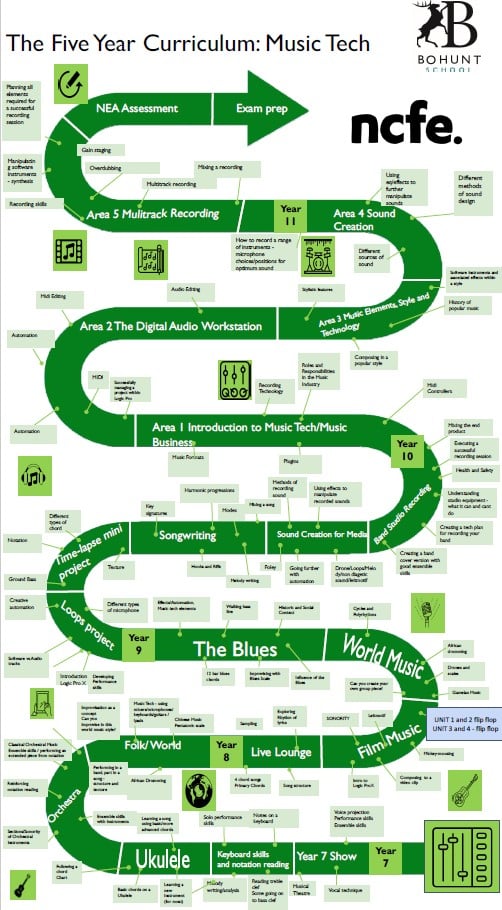
All students are given the opportunity to develop instrumental skills further through engagement in additional instrumental lessons with the visiting peripatetic staff. Extracurricular musical opportunities develop creativity and expression- including choirs, orchestra, bands, music tech and school productions.
>Schemes set out pathways for progression in the 3 pillars of interrelated musicianship. They are performing/rehearsing and listening. There is also an added pillar of the spiritual, moral, social, cultural aspects of music.
Curriculum Intent
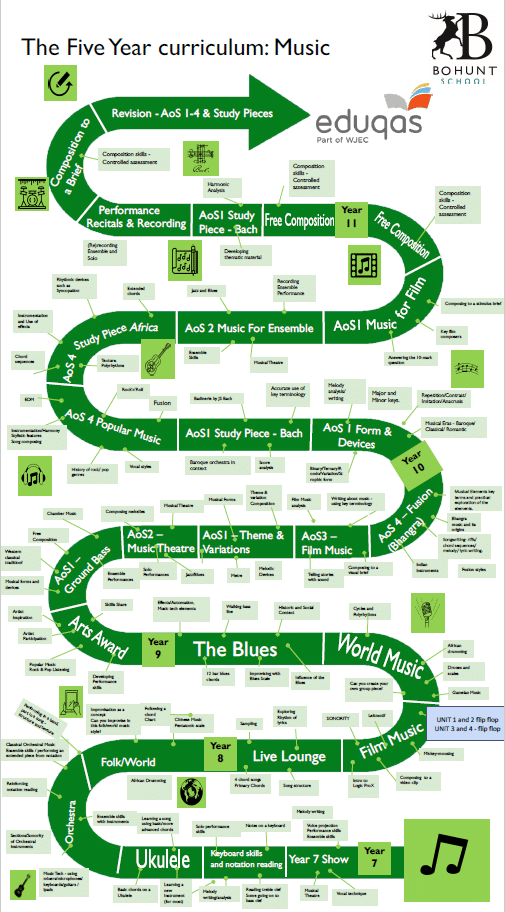
The BET Music curriculum at Bohunt is designed to inspire and ignite a love of music across all genres and eras. Students are encouraged to develop their theoretical and analytical skills through practical playing and performing. Students will develop ensemble skills from the beginning of Year 7 – creating a collaborative and engaging musical experience on a range of instruments.
Implementation:
Impact
The music curriculum offers inspiring, challenging and engaging musical experiences for all students. This is demonstrated in lessons and in the wide ranging Co-curricular opportunities that we offer including Co-Curricular clubs, instrumental lessons, school concerts, community performances, carol concert, music festival, outdoor cabaret and school musical.
Clubs:
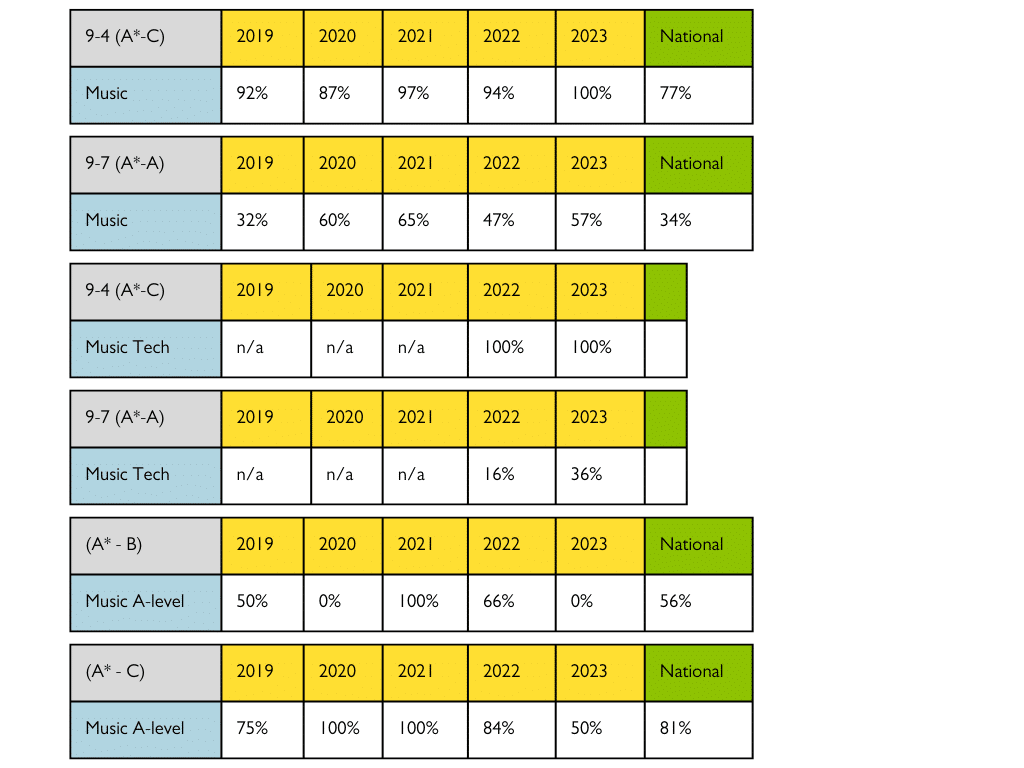
Learner Outcomes:
Intent:
The Drama Curriculum at Bohunt School aims to develop and support creative flair, self expression and a love of theatre, whilst encouraging collaboration and reflection through deepening oracy skills. It aims to engage and enrich students’ understanding of the subject and the world around them, through a broad and relevant range of compelling theatrical texts and experiences.
Implementation:
D: Developing creativity and self-expression: drama lessons and co-curricular opportunities empower all students to explore and expand their imaginative capabilities, take on challenging roles, work in collaboration and create work they didn’t know was possible.
R: Reinforcing resilience: drama teaches invaluable life skills, encouraging students to overcome challenges and face uncertainties with confidence, developing self-esteem and personal growth from KS3 upwards.
A: Allowing for artistic expression: drama provides a unique platform for students to communicate, connect and convey emotions through various forms of performance.
M: Mastering effective communication skills: drama lessons enhance oracy and literacy skills by promoting active listening, high quality talk and understanding of non-verbal cues through focusing on physical and social skills.
A: Appreciating diversity: drama fosters an inclusive environment where students can explore different cultures, perspectives and experiences, promoting empathy and understanding and encouraging acceptance, collaboration and reflection.
The Drama curriculum offers students the chance to explore and enrich their knowledge, skills and understanding of drama via a range of mediums and opportunities, which link to the AQA Drama GCSE specification.
Lessons are designed to provide students with space to develop their confidence working with others, whilst also enhancing their performance and presentation skills along with their oracy skills and physical presence.
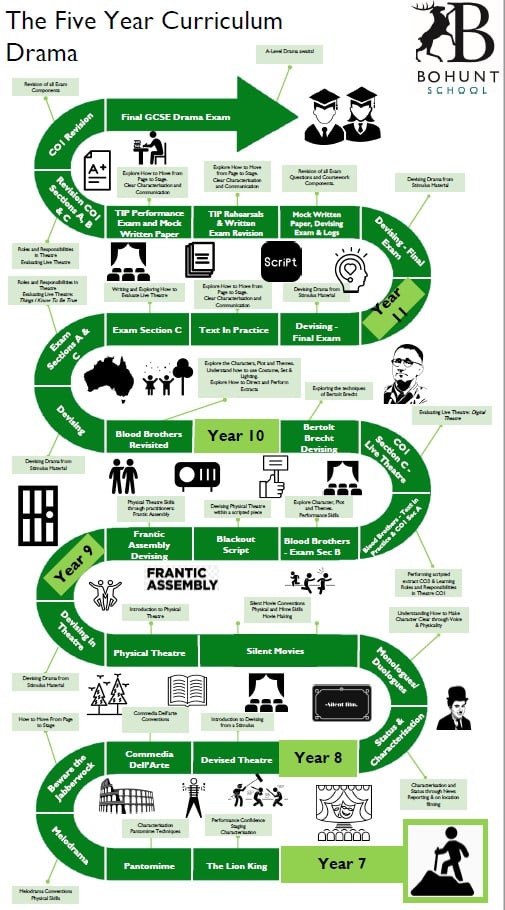
The Drama curriculum is presented over five years as follows:
Impact:
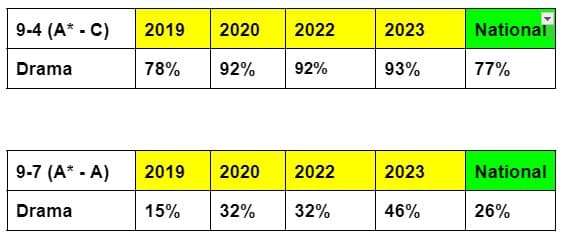
Within Drama we have successfully established a meaningful, wide curriculum, alongside AQA Drama GCSE where students are supported to flourish in their GCSEs and as they move upwards into further education. This is showcased in our high above national averages results, noted below and the positive, engaged students who feedback what an impact, difference and valuable experience Drama at Bohunt has given them.
Alongside our curriculum, we also run a varied and popular array of co-curricular opportunities for students throughout the school. These include:
Learner Outcomes:
Intent:
The Dance Curriculum at Bohunt School aims to enthuse a life-long love of Dance. Develop and support creativity in choreography, strengthen performance technique and encourage individual styles to evolve.
Encourages students to be challenged and supported to learn imaginatively about the world around them, by expanding their skills for creating, performing and evaluating Dance.
Engaging students of all abilities to feel personal success, by offering a plethora of styles and a variety of professional dance works to inspire our students.
Expanding collaborative skills, by promoting enjoyment and positive communication when working ambitiously with others in the classroom and at co-curricular opportunities; clubs, workshops, trips and competitions.
Instilling confidence, promoting self-empowerment and offering opportunity to inspire others, through a committed approach to creating work.
Utilising new Dance specific vocabulary to support confidence with analysis of their own and others work
Offers opportunities to study and embed other subject skills through dance such as Maths, Science and literacy skills in our year 7 schemes of work.
Offering an expansive and exceptional range of professional co-curricular opportunities from KS3 to KS4.
Our carefully crafted Dance Curriculum aims to support and excite students to achieve the highest goals and ambitions, allowing students to become increasingly culturally aware, empathetic and confident game changers.
Implementation:
The Dance Curriculum is designed to provide a broad spectrum of dance styles, stimuli and opportunities for all students.
Lessons are focused on enjoyment and engagement in active, creative and imaginative tasks which provide students with the tools to develop self-confidence, leadership and team work skills. In each lesson students appreciate, choreograph and perform dances amongst their peers – the culture created in the dance studio allows students to celebrate those performances and build one another up.
Dance is a lesson which students look forward to, a lesson where they are allowed freedom for creativity and guided to explore the form of dance in its many styles. We inspire students through the use of professional dance work on screen, through tasks which are fun and team-based and through an atmosphere which is positive and nurturing.
Impact:
The Dance curriculum provides learners with the opportunity to apply practical and choreography skills to a wide range of styles and genres, students are empowered to develop a deeper understanding and application of artistic and expressive forms of dance and performance across key stage 3 and 4.
Students across the school are encouraged to participate in a range of co-curricular opportunities in Dance, such opportunities range from performances on the “big stage”, trips and visits along with regular clubs to develop and hone personal skills.
Co-curricular opportunities:
Boys Dance Club
Acro-Dance Club
Performances at Haslemere Fringe Festival
Easter Dance Showcase
Site sensitive performance
Trips to “Move it” and Pineapple Dance Studio
Workshops with Stopgap Dance Company
Workshops with Middlesex University
Learner Outcomes:

Intent:
The Visual Arts (Art, Photography & Textile Art) inspire our students to be independent, inquisitive and creative thinkers through demonstration, support and freedom. We encourage learners to develop autonomy and enquiry skills; growing their understanding of the world through skills-based tasks and discussions about the impact of cultural events. Creating game changers who thrive in an environment of risk taking.
We aim to grow our students’ understanding of the world around them, through nurturing and challenging their interpretation of the art and creative forms that they see. Students will develop a medium for self expression and their understanding of the world through skills based tasks and applying a range of mediums and techniques.
We prepare our students for the future, equipping students with the knowledge, skills and techniques. We encourage experiment and take risks with their creativity, and to appreciate Art in its many forms.
Implementation:
The Art Curriculum is designed to introduce students to a wide range of techniques, materials and artists. Students will work through 1 module per term developing their practical skills and critical thinking. Each module develops a balance of skills, knowledge and understanding allowing students to maximise their creativity whilst also enhancing their social, historical and cultural understanding of style.
KS3:
There is a focus within this key stage on formal artistic elements including the use of line, tone, colour, form and shape. Students develop their exploration of the mediums of drawing, painting, collage and chalk work focusing on Matisse, Jason Scarpace, Van Gogh and Jane Hissey. As the terms progress students will focus on developing further skills in experimental drawing, tonal drawing, mono printing, painting, textiles, creative collage and photography.
KS4:
At key stage 4 students have the opportunity to continue to expand on the skills and knowledge they developed in key stage 3. Students are encouraged to become independent and self-determining in their study responding to art and design whilst exploring their personal interests and styles. Student have the opportunity to explore Visual arts via the focus of Art, Photography or Textiles
Impact:
The Visual Arts department have created an engaging and creative curriculum supporting learners to become resourceful and culturally rich in their understanding and application of inventive and imaginative styles and skills. Students are independent in their application of concepts and are encouraged to explore a range of ideas to allow reflection and improvement as part of the development process. Students are encouraged to take risks and create work which reflects them and their artistic styles.
Alongside curriculum activity students across the school are encouraged to participate in a range of co-curricular activities in order to underpin their knowledge and understanding of art and its various forms. Such activities include:
Field trips include visits to:
Learner Outcomes: