
Back to list
Head of Faculty: Shaf Hansraj (Humanities)
Head of Department : Bronwen Scales ( History)
Head of Department: William Chrystal (Ancient History)
Head of Department: Robert Hall (Geography)
Head of Department: Cameron Macintyre (Religious Studies)
Head of Department: Jonty Duggan (Psychology)
Head of Department: Paul Jenkins (Sociology)
E: enquiries@bohunt.hants.sch.uk; T: 01428 724324
Intent
‘History is usually presented as a set of facts and dates of victories and defeats, or monarchs and presidents. But it’s not like that at all. History is the knitting together of rival interpretations: deliberate manipulations of the truth and sometimes alternative facts.’ Lucy Worsley 2019
To empower our students with the historical knowledge and skills to understand the past and, through it, the present.
History is far bigger than a GCSE exam.
All our students can change the world for the better. Our History curriculum is designed to help our students to become game changers by:
Implementation
The Key Stage Three Curriculum fully meets the requirements of the National Curriculum. We study the curriculum in a chronological breadth study. Planning topics in time period, with the use of some case studies, helps to develop understanding of key themes rather than being covered in depth. Big Picture Mastery lessons are taught at the end of each time period to develop students schema and to understand changes to each theme.
The History curriculum includes the seven areas specified in the National Curriculum: development of Britain during the periods from 1066-1509; 1509-1745; 1745-1901; 1901 to the present, including the Holocaust; a local history study; pre-1066 study; and at least one world history study.
The Key Stage Four Curriculum is sequenced to allow progressive development of disciplinary
concepts throughout the units covered.
As with the Key Stage Curriculum , students also complete Big Picture Mastery lessons, allowing them time to consider how the four core themes apply to the four different units studied. This again helps to build their schema and give them opportunities to explore the units beyond the specification.
Download the History Learning Journey
Impact
History is about knowledge and learning from the past and this is what you achieve when studying History at Bohunt School. The skill set students develop will support them in becoming an inquisitive, curious and well-rounded learner that has a keen interest and awareness of the past and its impact on their future. We also have many students that continue their History studies at sixth form and universities across the country including Oxford. History is an important subject that allows students to enquire about different cultures, societies and politics allowing for accomplished and educated views to be made.
Local and international trips – IWM/Berlin/ Battlefields/ Mary Rose
Talks – Holocaust Survivors, key historians through our sixth form programme
Clubs – Debate clubs on key Historical and Political events through the Model United Nations club and Humanities Club.

“To equip students with the ability to develop interpretations of spaces & places around them and promote tolerance and respect in a diverse world, enabling them to develop deeper knowledge, wider understanding and the geographical skills to meet the challenges and take an active role in a dynamic future.”
Geography provokes and answers questions about the natural and human worlds, using different scales of enquiry to view them from different perspectives. It develops knowledge of places and environments throughout the world, an understanding of maps, and a range of investigative and problem solving skills both inside and outside the classroom. Geography is a focus within the curriculum for understanding and resolving issues about the environment and sustainable development. It is also an important link between the natural and social sciences. As pupils study geography, they encounter different societies and cultures. This helps them realize how nations rely on each other. It should inspire them to think about their own place in the world, their values, and their rights and responsibilities to other people and the environment.
The aims of the Bohunt Geography Curriculum is to create a 5 year program of study allowing students to:
Receive challenging and engaging provision focused on developing them as geographers.
Develop deep-rooted geographical knowledge of places in the context of both human, physical and relevant geographical processes.
Develop an understanding of relationship and interdependences at a variety of scales.
Develop the ability to question at a high level, debate, discuss and interrogate issues in detail.
Have the ability to use a range of geographical skills.
Have the opportunity to enquire and develop their understanding of fieldwork.
Regularly challenged to show a high standard of literacy and numeracy.
To understand future challenges particularly sustainability and climate change.
Key stage 3:
As a trust we have worked together to build on the national curriculum making use of the national college curriculum planning guidance to develop the NC strands into our own. These are then mapped through our KS3 SOW to ensure parity of exposure. These key concepts are found in the table below. These key concepts, along with the key skills of a Geographer underpin our curriculum design.
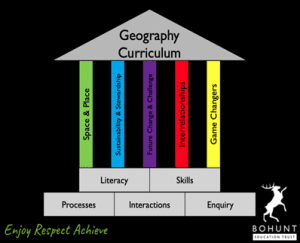
We begin our KS3 curriculum by establishing a baseline of both Geographical skills and content knowledge, through a bridging unit to identify any areas of misconceptions from The range of KS2 providers. We have identified the key skills of a well-rounded Geographer and utilise our curriculum as the vehicle to deliver these key themes. The progression of skills is built into a spiral curriculum which are revisited over time throughout the content. The first year of KS3 ends with a plenary unit, tying together all skills and content through the use of a place study.
The second year of KS3 continues to build upon and simultaneously revisit the progression of skills and throughout the content delivered. The implementation of a Contemporary Global Issues unit also takes us further than the boundaries of the National Curriculum whilst developing enquiring and well rounded Geographers to ensure a holistic geography education as we are aware not all students will progress with our subject to KS4.
Key Stage 4:
Key Stage 4 curriculum follows the AQA Geography Specification and mirrors the focus on skills, physical and human geography from key stage 3.
Year 9 – B ridging unit and GCSE Skills, Living World, Managing Resources and River Landscapes
Year 10 – Urban Challenges, Natural Hazards, Coastal Landscapes & Fieldwork
Year 11 – Changing Economic World & Issue Evaluation
Download the Geography Learning Journey
The Geography team ensures that students have a range of opportunities to apply the skills learnt in lessons to the practical environment, exploring the spaces and places around them and applying the key pillars of Geography.
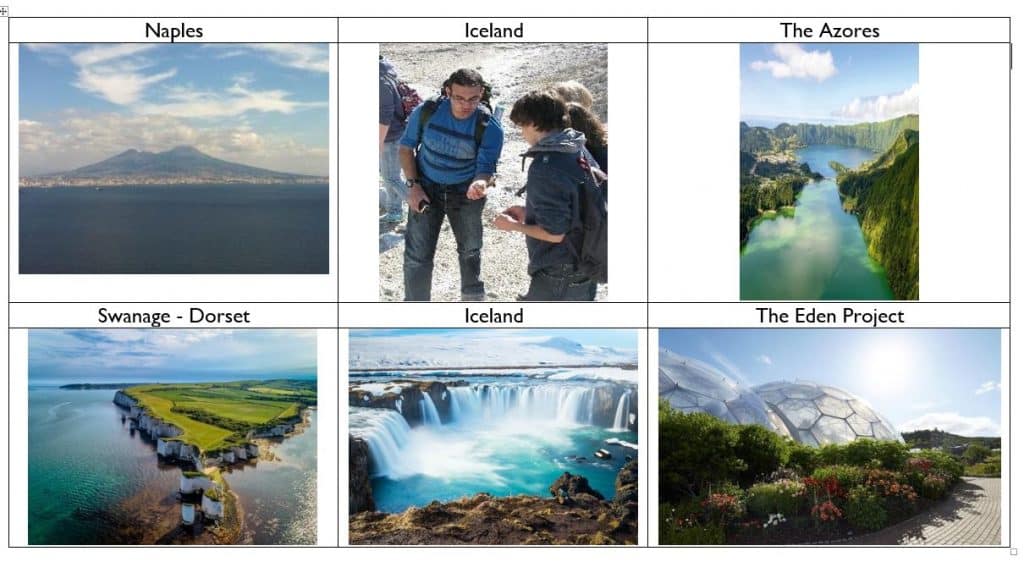
Learners have the opportunity to take part in a residential trip to Swanage in Dorset in Year 10 to look at coastal landscapes and processes and how the area is used by people and to the Eden project in Cornwall, in Year 8 to look at Ecosystems. Local area Field work to Selsey in KS4 allows students to test hypothesis whilst overseas field visits provide the learners with the opportunity to look at tectonics and glaciers in South Iceland, sustainability, tourism and tectonics in the Azores and tectonic activity and tourism in the Bay of Naples.
As a result of our approach Bohunt has one of the largest GCSE Geography cohorts in Hampshire with approximately 160 students opting for the subject each year and growing numbers at A Level within Bohunt 6th form.
The Geography department has a long tradition of enriching the ‘taught curriculum’ with activities which promote ‘awe and wonder’. We believe that deep learning starts with a passion for the subject and as such our enrichment program is designed to ignite this through:
Fieldwork
Outdoor education/DofE
AMA Day (Portsmouth University)
Future plans for Environmental Conference
World Environment Day
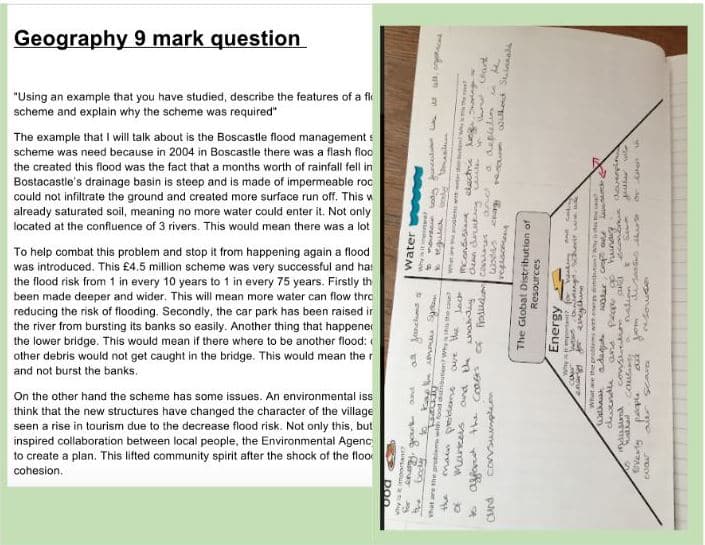
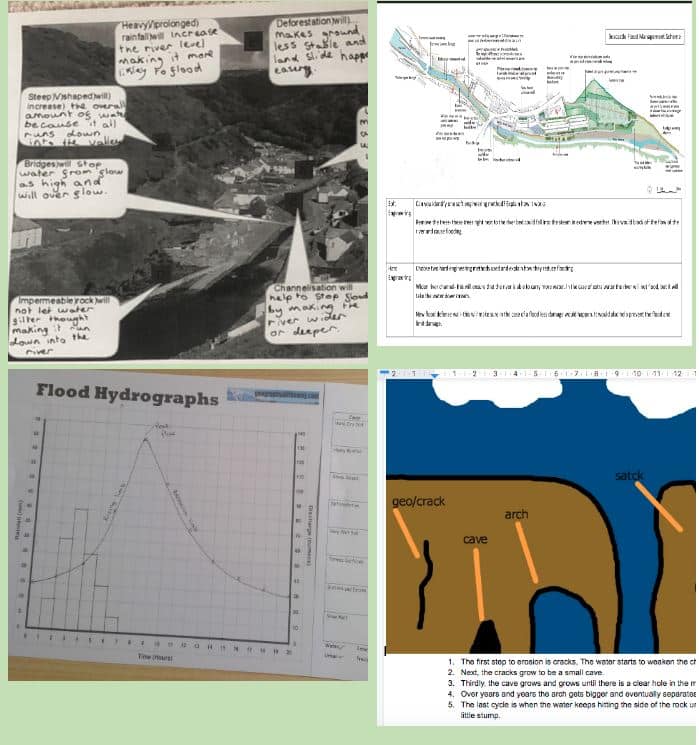
Typical Student Work from KS3
The Geography department follows the AQA GCSE syllabus; this aims to highlight the critical importance of Geography in understanding the world and stimulating interest in places. It will inspire pupils to become global citizens by exploring their place in the world, their values and responsibilities to other people and the environment. The course is examined at the end of KS4 with the aim of enabling learners to develop in maturity and expertise before undertaking their exams.

Religious Studies and Citizenship (RSC) at Bohunt equips students to become the change they wish to see in the world by building mutual respect, understanding, and promoting the importance of courageous advocacy.
The teaching of Religious Studies makes links between the beliefs, practices and value systems of a range of faiths and world-views. The Religious Studies curriculum will help to develop responsibility and respect for all aspects of diversity, whether it be social, cultural and religious, and prepare pupils well for life in modern Britain.
The overarching skills and concepts for ‘Religious Studies’ at Bohunt School are:
Skills:
Critical Thinking
Social
Communication and Reflection
Evaluation and Application
Concepts:
British Values
Belief
Identity (including cultural)
Spirituality
Morality
Implementation
At KS3, we implement our Religious Studies programmes of study through a carefully planned, broad and balanced curriculum, which is in line with the pedagogy outlined in the Hampshire Agreed Syllabus ‘Living Difference 3’. This is student-centred, conceptual enquiry (demonstrated in the diagram below) with deep philosophical, moral and religious questions at the core of learning.
This curriculum was selected from Type 2 & 3 concepts in the Locally Agreed Syllabus (Living Difference) and influenced by NATRE. These are what we have identified as the key foundational concepts required for a student to have basic, but broad and balanced religious literacy and religious understanding. In KS4 all students receive one hour per week of Religious Studies. Through building on key concepts from KS3 students will apply prior learning to ethical and philosophical ideas, and further explore world faiths and cultures.
At GCSE, we use the same pedagogy, but base our Religious Studies programmes of study around the guidelines found in the AQA Religious Studies A Syllabus. Students will study the beliefs and practices of two religions: Buddhism and Christianity, interleaved with four ethical themes.
At KS5 we offer A Level Religious Studies following the OCR Syllabus. Students will study Philosophy, Ethics and Religious over a two year course.
Download the GCSE RS Learning Journey
Impact
Religious Studies at Bohunt provides students with the opportunity to develop further as ‘Game Changers’ by exploring worldly views and reflecting on their own spiritual, moral, social and cultural development.
Religious Studies at Bohunt develops students’…
Knowledge and understanding of World Religions.
Understanding and respect for different beliefs, values and traditions.
Understanding of the influence of faith and belief on individuals, societies, communities and cultures.
Skills of enquiry and response through the use of religious vocabulary, questioning and empathy.
Skills of reflection, expression, application, analysis and evaluation of beliefs, values and practices, and the communication of personal responses to these.
Extracurricular opportunities:
Within the Religious Studies department we encourage extra curricular opportunities to enhance students’ learning and understanding. We have guest speakers from Winchester and Southampton Universities to provide an insight into studying Religious Studies, Theology, Philosophy and Ethics at an academic level.
We also run trips to Rome, Buddhist monasteries and the Ashmolean. These opportunities provide students with the opportunity to develop as ‘Game Changers’ beyond the classroom.

Psychology – Intent
The Psychology course at Bohunt School fits in perfectly with the school values of Enjoy, Respect, Achieve. We aim to help children to develop into learners who question the people around them, enquire about the things they see and seek to understand people’s behaviour. They become inquisitive about the people they see around them and enjoy discovering theories that have such high real world applicability. Throughout this discovery process they also come to understand the complexity and variation of human experience, which fosters respect and drives out stigma surrounding mental health and human behaviour. Finally, our students achieve more than just a grade in their studies of Psychology. We focus on skills such as crafting an argument, collaboration, synthesis and presentation of information and independent research. Studying Psychology at Bohunt cultivates young people who enjoy learning about the people around them, citizens who respect and understand mental health and students who develop the necessary skills to achieve.
Psychology – Implementation
At KS4, students cover a wide range of topics that help them to understand the world that they live in and the people that live in it with them. The introductory course has been designed to introduce them to the different ways in which we can approach Psychology while building engagement and enjoyment by choosing an interesting study or theory from each approach. They then focus on the study of Criminal Psychology as this demonstrates how a combination of environmental influences and biological factors can change the same behaviour. This understanding of multiple academic arguments builds a firm foundation for future study in Psychology, but also in other subjects where there may be differing views and opinions. Furthermore, it develops an understanding of how Psychological theory can apply to real life while building an awareness of the justice system and the consequences of their actions.
These principles are then built upon throughout the KS4 curriculum as we apply them to other approaches in Psychology: the study of child development and learning, mental health and psychological problems, social influence, memory and finally sleep and dreaming. By the end of year 11 students will be prepared for further study in Psychology, other social sciences and many other subjects. Perhaps more importantly they will have also developed an appreciation of academic debate, mental wellbeing and the behaviours of those around them.
GCSE content: Criminal Psychology, Development, Psychological Problems, Social Influence, Memory, Sleep and Dreaming, Research Methods, Neuropsychology.
Download the Psychology Learning Journey
Psychology – Impact
Students studying GCSE Psychology show an increased understanding of human behaviour and the impact of Psychological research. For example, the study of Criminal Psychology allowed students to consider the factors involved in determining whether someone might commit a crime. The variety of theories led them to form different arguments around the question ‘are criminals born or made?’ This, in turn, produced excellent discussion regarding how criminals should be dealt with, what the purposes of prison are and whether society should punish or rehabilitate their offenders.
This understanding of causes of human behaviour inevitably increases tolerance and reduces stigma. In addition to developing a more rounded view of criminals, students have considered mental health and how it affects everyone. They have learnt to see mental health not as a single disorder or illness, but as a spectrum, and explored how they can look after themselves and their friends. They have also looked at the different ways in which people learn, the devastating effects of brain injury and the significant historical implications of obedience. Students have developed their scientific research skills by carrying out their own projects. Finally, and most importantly, students love Psychology. They enjoy learning theories that help them to understand the people around them and many are looking forward to continuing with the subject in further study.

Sociology will enable our young people to understand their place within an ever-changing social world. GCSE Sociology helps students to gain knowledge and understanding of key social structures, processes and issues through the study of families, education, crime and deviance and social stratification. Students will develop their analytical, assimilation and communication skills by comparing and contrasting perspectives on a variety of social issues, constructing reasoned arguments, making substantiated judgements and drawing reasoned conclusions. By studying sociology, students will develop transferable skills including how to investigate facts and make deductions (important in a world of ‘fake news’ and alternative facts’), develop opinions and new ideas on social issues (such as ethnic and gender inequality) and better analyse and understand the social world (a world in which they will be playing a key part in)
Sociology is taught according to the four main examined units (with research methods included in each unit).
Foundation concepts are covered in year 9 within an introductory course during the first half-term, leading to more complex application of theories and concepts throughout the four main units of Families, Education, Crime and Deviance and Social Stratification. The scheme of work allows students to learn research methods at the same time as the first unit – Families. This means that students become skilled in ‘applying’ research methods to the context.
Research methods topics are integrated into appropriate places of the course so that they are learned in context, rather than as stand-alone topics.
There are key points in the first year where time is given to conceptual understanding of Sociology and development of skills in order to develop a broader, more versatile curriculum.
Topics covered:
Theory: Functionalism; Marxism; Feminism; Postmodernism; Interactionism
Methods: surveys; interviews; observation; experiments; primary and secondary data
Families: functions of families; family diversity; domestic roles and power in couples; childhood; marriage, cohabitation and divorce; impact of social policies
Education: functions of education; differential educational attainment relating to social class, gender and ethnicity; impact of social policies
Crime and Deviance: types of crime; explanations for crime and deviance; punishment; patterns of crime relating to gender, class and ethnicity
Social Stratification: social stratification and differentiation; different views and explanations of social class, gender and ethnicity; wealth, poverty and welfare.
The-Five-Year-curriculum-SociologyDownload
In an uncertain world, sociology gives our young people the opportunity to understand the quickly and ever-changing social landscape. At a period of huge disruption and risk, Bohunt sociology students are critical thinkers who can support reasoned and balanced arguments with sound and robust evidence. The study of sociology enables our young people to put their own life experiences into context and acknowledge that their experience of the world is not necessarily typical. Many students are often surprised by the huge inequalities that exit and persist despite the variety of interventions intended to abate such inequalities. Studying sociology enables students to understand the causes and consequences of social issues and problems and encourages them to be active agents of social change. All students in the 2018-2020 cohort either achieved or exceeded their predicted grades which enabled them to enter their first-choice university or continue with further education, employment or training.
Planned A level visit to the V&A Museum of Childhood and the Ragged School Museum in East London
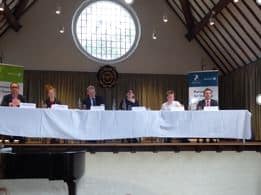
A Level visit to Bedales: Education in an uncertain world – ‘Question Time’-style panel
Planned lecture on Families and Social issues delivered by a senior lecturer from the University of Portsmouth
A Level Sociology Conference 2021 (UCL Institute of Education)
Opportunities to attend lectures (in-person or virtually) at Gresham College in the City of London
The first cohort of GCSE students are due to be examined in May/June 2021

Intent
Ancient History inspires and empowers students to learn about ancient societies and peoples in order to understand and make judgements about their relevance to the modern world.
The GCSE course, while focused around the substantive knowledge of cultures and civilisations from the past, also helps students to develop vital disciplinary skills such as significance, change and continuity, similarity and difference as well as causation. As well as this they will develop their ability to analyse and engage critically with both material and literary evidence in order to make informed judgements and analyse different perspectives.
Implementation
At KS4, students cover a wide range of topics that help them to understand key ancient societies and the impact they still have within the modern world. The introductory course has been designed to introduce students to the ancient Roman Republic as well as the key themes of political, social, military, economic and cultural change that they will explore throughout their GCSE. The introductory content is based around studying the Roman Republic and Empire to explore the power that mythology and propaganda held within the Ancient World; and still holds today. The first GCSE module is about the foundations of the Rome and through this they start to develop the disciplinary skills of causation, change and continuity as well as analysing ancient sources. Next students move onto studying the ancient Persian Empire, building on previous skills, alongside their chronological understanding and knowledge of similarity and difference. The depth studies on Alexander the Great and Cleopatra and Rome finish the course utilising all the skills and knowledge the students have built so far as well as going further into the use, analysis and interpretations of ancient sources. Students will also be asked to make evidence based judgements on the significance of historical events using the collection of skills they will have developed. By the time students leave KS4 they will have a sound understanding of some of the most important events in the ancient world allowing them to continue their study or apply these lessons to other subjects as varied as modern History, Law, Politics, Philosophy, Religious Studies or Classical Civilisations.
GCSE content: Foundation of Rome: from kingship to republic 754-440BC, The Persian Empire 559-465BC, Alexander the Great 356–323 BC, Cleopatra: Rome and Egypt 69–30 BC.
Download the Ancient History Learning Journey
Impact
Students of GCSE Ancient History finish with an increased knowledge and awareness of how our modern society has been formed and the key structures that it is made up of. For example, students will have looked at the formation of Democracy in Athens in comparison to the monarchy of the Persians. They will understand the huge importance of the civilisations in the modern Middle East to the formation of language, medical progress and maths – among other things. They will have seen why Greek religion, language and culture (and therefore western culture) spread so far throughout Europe, the Middle East and Central Asia while studying Alexander’s conquests. Finally, they will understand why Greek and Roman ideas have had such a large impact throughout Europe following the victory of Augustus against Cleopatra and Marc Anthony leading to the supremacy of the Roman Empire. Ancient History does not purely cover the deeds and actions of so-called ‘great men’ but looks at how the political, cultural and religious changes made in these periods permeated throughout history and were passed on to future generations. Students will be able to understand the key ideas that underpin our own sense of self in the 21st century and see the huge numbers of commonalities we possess with those living up to 5000 years ago. The skills developed will allow students to critical analyse evidence and make reasonable, rational judgements based on the weight of evidence. This has always been, and is possibly becoming even more of, an incredibly important skill for navigating the modern world. This key skill will allow learners to navigate through the endless sources of information to decide what is valid and what is inaccurate or false.
Co-curricular opportunities
Local and international trips – British Museum, Rome and Naples
Clubs – Debate clubs on key Historical and Political events through the Model United Nations club, Humanities club

Intent
Classical Civilisation inspires and empowers students to learn about ancient societies and peoples in order to understand and make judgements about their relevance to the modern world.
The A-level course is structured around the History, Art, Politics, Philosophy and Literature of Ancient Greece and Rome. Through studying a diverse range of ancient material, students will learn to make connections and comparisons between these ancient societies and their own culture. Students will develop key skills such as the ability to articulate an informed response to the visual, cultural and literary material studied, using a range of appropriate evidence to formulate coherent arguments with substantiated evidence based judgements. They will also further develop their skills of critical analysis and evaluation and apply these to the range of source materials studied in order to gain insight into aspects of the classical world
Implementation
At KS5, students in Classical Civilisation cover a mix of topics, themes and time periods. The main focus of the course is on Classical Greece and Rome, but the literature elements also covers the Late Bronze Age Trojan War through our study of Homer’s Odyssey and Virgil’s Aeneid. The course is divided up into two sections: one covering the key political, social, cultural, economic and military changes within Classical Athens and early Imperial Rome under Augustus; the other studying Homer’s Odyssey and Virgil’s Aeneid drawing out the key context, themes and meaning behind the texts as well as analysing the literary techniques used. The works of Homer are the foundation of the Western literary canon, and the Greeks themselves considered them the cornerstone of Greek culture. Virgil was directly inspired by Homer ad this is reflected within the structure, composition, and key themes within the Aeneid. With their unique composition and exciting tales of gods and heroes, these works of literature form an excellent grounding for exploration of the classical world.
In Imperial Image students will have the opportunity to explore visual and material sources – alongside the literary – in order to deconstruct the first emperor Augustus’ image and propaganda and analyse how he was able to convince a fundamentally anti-monarchical society to accept one-man rule. Finally, within Democracy and the Athenians learners will look at how democracy permeated Athenian identity, how it was celebrated and idealised, but also how it was criticised. The concepts of ‘popular’ leaders who mislead the people, or give them what they want rather than what they need, and a voting public who may not be fully informed on the issues, will resonate with students in the modern world and make this study particularly engaging and relevant.
Impact
Students of A-level Classical Civilisation finish with an enhanced understanding of the relevance and importance of the classical world to modern society. They will have explored how the Odyssey and Aeneid have played a foundation role in western literature, guiding, and directly influencing key themes and structures ever since. They will also have explored the political, cultural, and linguistic structures that underpin our own through their study of Athenian Democracy. Within this module we explore the rule of law and how developments that we take for granted in the modern world, such as jury courts, developed out of the Athenian system. The Imperial Image module has a striking relevance to the modern world with its focus on critically analysing method, purpose, and message of visual and material sources. Students will develop a keen sense of how to tell propaganda from fact and how to deconstruct evidence in order to make valid, substantiated judgements about it. Through their studies in Classical Civilisation students will have explored Art, Literature, History, Politics, Philosophy, Law, Religion, Drama and more making this a diverse and rewarding subject for all learners.
Co-curricular opportunities
Local and international trips – British Museum, Greece (tour around the Ancient sites)
Talks – Multiple guest speakers (either virtual or physical), Cambridge statue museum tour.
Clubs – Debate clubs on key Historical and Political events through the Model United Nations club, Humanities club


