In 2010, Bohunt School – the founding school of the nine-school family, Bohunt Education Trust, was the first school in the UK to introduce immersion language teaching (CLIL – Content and Language Integrated Learning).
This innovative teaching pedagogy sees a group of students in Key Stage 3 taught a third of their curriculum in the target language: French, Spanish or Mandarin. Native language speakers take tutor time and teach subjects like PSRE, Art, Drama and PE. We have also taught Maths, Science and History in the target language. The approach is so innovative that, when first introduced, it was shown by students from Bohunt School being asked to visit David Cameron, the UK’s Prime Minister, to teach him Mandarin before his visit to China.
The choice of this style of learning came out of an in-depth discussion of why we teach languages. We don’t teach students languages so they can get outstanding grades in their exams, we teach them languages so they can thrive in foreign countries that speak that language; we teach them foreign languages so they can be great linguists. CLIL goes far beyond just teaching a student a language though. Immersion/CLIL teaching enables teachers to challenge students cognitively, whilst improving their linguistic skills.
Communication is the key to progress. If students can communicate about learning in Drama or IT via the target language then they are gaining knowledge of the subject and advancing their language skills. The cognitive learning should not be compromised to accommodate their level of language. The teacher needs to prepare material that is accessible yet still cognitively challenging. Their ability to persevere, problem solve, work collaboratively, work independently and link up their learning are all skills that are explicitly developed in a CLIL programme.
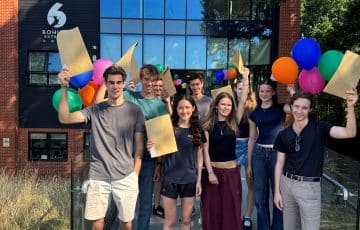
The evidence that the approach is working is clear. First of all, and unsurprisingly, the language results are superb. Students take their GCSE languages at the end of Year 9, two years early, as they are ready: in 2019, an incredible 100% grades 9-5 (96% achieved grades 7-9).
The impact of the cognitive challenge and enhanced behaviours for learning, developed through the need to work collaboratively in order to understand what is going on, is also clear. By the end of the first year of the programme, students in the CLIL groups are outperforming their peers in ALL subjects, not just their foreign language. By the time the students reach Key Stage 4 there is no clear gap in attainment, although they are still outperforming their peers in some subjects. In essence students are well equipped to deal with other challenges across the curriculum due to the transferable skills they have gained in the CLIL lessons; an emphasis on skills and communication is enhancing attainment. Even more interesting is the way that being in the CLIL group enhances students’ attitudes to learning. This gap doesn’t close over time (see graph below). The enhanced challenge, the students developing resilience and the students having enhanced communication skills is improving their attitude to learning overall.
CLIL was first introduced in 2010 with a French tutor group, followed by Spanish, French and then Mandarin in 2014. There are then two methods of delivery:
There are very few resources available for CLIL teaching and therefore Bohunt has collaborated with specialist teachers to ensure that it offers the CLIL student the same learning opportunities as non CLIL groups. We have had to innovate to create and maintain a communicative and highly active learning environment.
Students go on to do a Key Stage 5 course, the HSK Level 3 in Mandarin, the DELF B1 course in French and DELE qualification in Spanish. These courses are designed to prove the advanced language skills of non-native speakers. This has proved to be extremely challenging for the students as many of the topics are more suited to an older student with more life experiences, literary and academic knowledge. Furthermore, the gap between GCSE and KS5 is big and they need a strong grounding in grammar which the CLIL course endeavours to provide, beyond that of most students with a GCSE in a Modern Foreign Language.
Mthulisi joined us from Zimbabwe halfway through Year 9. As well as being recently elected to the Hampshire Youth Parliament, he is also a House Captain for Curie House and a Year 7 mentor.
Read More
Millie is a keen mathematician who has demonstrated consistent excellence in the UKMT Intermediate Mathematical Competition, achieving the top result in her year group for two consecutive years.
Read More
Earlier this year Seb competed in for Great Britain in both Norway and France. He was not only selected for the U17 GB Rock Climbing Team despite being only 14, but he also earned podium finishes at the national championships and has reached multiple finals overs the years.
Read More
Harry has already achieved incredible success in Athletics. This year alone he moved up to the U17 age category despite being 15 and is ranked as the 7th best 800m runner in the UK for any Year 11.
Read More
James is a core member of Bohunt School’s Expressive Arts department and attends every single club in the department. His interests continue outside school. He plays the trombone with the Hampshire County Training Band and has been in musical theatre productions of Les Mis, Anything Goes, Footloose, Legally Blonde, Oliver and Oklahoma.
Read More
Rivka’s musicianship is quite superb. She has amazing poise and confidence, and is always polite and friendly. As well as playing multiple instruments to a very high level, Rivka has been awarded a place in the National Youth Choir.
Read More
Darcey currently plays in the 1st team for the Hampshire U13 Cricket squad. She was selected from over 300 girls after a rigorous training programme.
Read More
Under Mr Duggan’s supervision Bohunt’s Psychology Department has gone from strength to strength. Following excellent GCSE results he was approached by the examination board to write a blog. In the wake of that Bohunt was selected as a GCSE Psychology Ambassador Centre.
Read More